


Resilience is often described as toughness, grit, or the ability to keep going. These descriptions are incomplete. They name the outcome without explaining the process. A more useful definition starts with a harder truth. Resilience is built through adversity, not comfort.
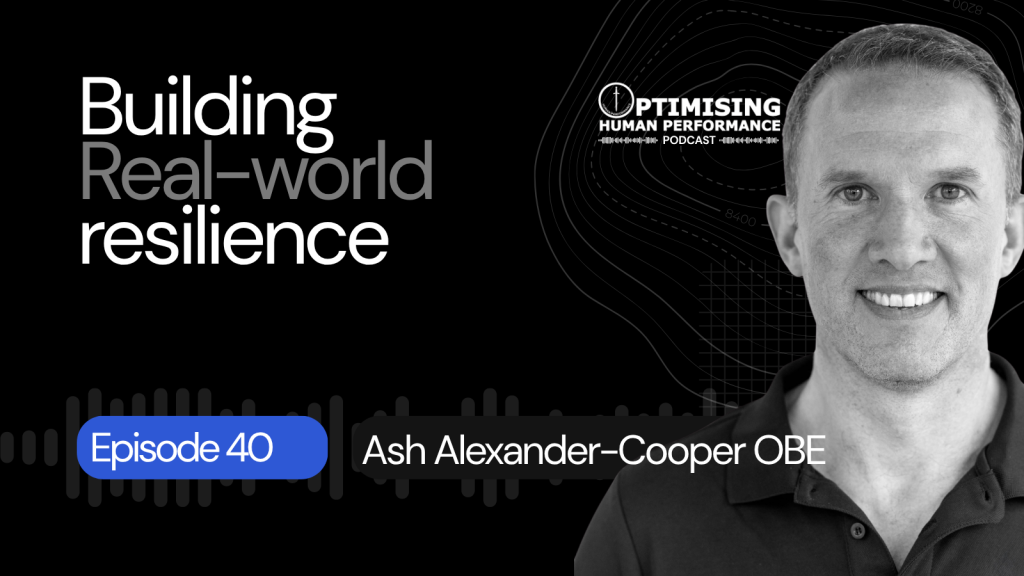
That idea sat at the centre of a recent conversation with Ash Alexander Cooper. Drawing on elite sport, military service, specialist operational roles, and later leadership work, his account was clear. People do not become resilient by avoiding difficulty. They become resilient by going through it, learning from it, and adapting to what it demands.
This matters for anyone interested in resilience in high performance environments. It shifts the focus away from slogans and toward the practical conditions under which people actually develop the capacity to cope.
Early adversity shapes later adaptation
One of the strongest themes in the discussion was that resilience does not begin in adulthood. It begins much earlier. Early instability, uncertainty, and loss can shape how people respond to challenge later in life.
Ash described a childhood marked by instability at home and a sense that safety could not be assumed. In his account, this did not produce a simple story of damage or strength. It produced a pattern. He learned to move quickly, to do more, and to take opportunities before they disappeared. Early adversity did not just create stress. It shaped adaptation.
This is consistent with what is known from developmental psychology. Early environments do not dictate who a person becomes. They do influence how people interpret risk, safety, control, and opportunity. This is relevant to any serious discussion of stress, adaptation, and performance.
Why teams build resilience better than isolation
Ash did not describe resilience as something developed alone. He repeatedly returned to sport, music, and military teams as places where challenge and safety coexisted. These environments demanded performance, but they also provided trust, belonging, and shared effort.
That is an important point. People often build resilience through teams, not apart from them. Good teams expose people to pressure while providing enough support and structure for them to keep functioning and learning. In this sense, resilience is not only an individual quality. It is something shaped by relationships and environment.
This connects closely with OPHP work on team cohesion and performance under pressure. The quality of the group often determines how individuals respond when stress rises.
Exposure matters, but only when it teaches something
A central claim in the conversation was that resilience requires exposure to difficulty. If people are never challenged, they do not build the experience or confidence needed to deal with later adversity.
That claim needs caution. Exposure alone is not enough. Repeated difficulty without support, reflection, or recovery can be damaging rather than developmental. The value lies in what follows the stressor. People need challenge that stretches them, support that keeps them engaged, and enough recovery to absorb what happened.
This is why training for pressure and uncertainty matters. Good training does not remove stress. It introduces it in forms that allow people to develop a more effective response before the stakes are at their highest.
Real pressure still feels different
Ash’s description of his first major gun battle made that point vividly. He had trained extensively. He had already operated in demanding conditions. Even so, the first real contact that involved being hit, losing colleagues, and dealing with chaos exceeded anything his system had fully rehearsed.
That does not mean the training failed. It means there are limits to what training can simulate. The purpose of preparation is not to remove shock. It is to improve the chances that people can regain control quickly enough to act effectively once the initial shock passes.
This is a useful reminder in any discussion of performing under pressure. Early disruption does not automatically mean failure. What matters is whether people can reorganise and re-engage with the task.
Physical readiness protects mental capacity
One of the most practical points in the discussion concerned physical fitness. Ash’s view was not simply that fitness improves performance. It was that physical preparation reduces cognitive distraction.
If the body is underprepared, pain, fatigue, and doubt consume attention. That leaves less mental capacity for judgement, awareness, and leadership. If people trust their physical preparation, they have more room to think clearly when pressure rises.
This fits a broader OPHP principle. Performance often improves when you remove avoidable drains on attention. Sleep loss, poor nutrition, unmanaged pain, and inadequate preparation all compete with the task. This is why sleep and performance, physical readiness, and cognitive capacity are so tightly linked.
Resilience depends on how people read discomfort
Ash also described learning to treat pain as a phase rather than as a command to stop. That distinction matters. Two people can experience similar discomfort and respond very differently depending on how they interpret it.
One person may read discomfort as evidence that they are failing. Another may read it as an expected part of the process. The sensation may be similar. The meaning changes the response.
This is one reason experience matters so much. Experience gives people reference points. It helps them recognise that some forms of discomfort are survivable, temporary, and part of moving toward the next stage of performance. This is central to building resilience through adversity rather than merely enduring it.
Courage is moving through fear
The conversation also sharpened the relationship between resilience and courage. Ash made the point well. Courage is not the absence of fear. It is the decision to move through fear.
That distinction is important. Fear is often treated as a weakness or a signal to retreat. In reality, fear is often the expected response when the stakes are real. The question is whether people can continue despite it.
Ash described this in terms of comfort, fear, learning, and growth. The comfort zone is where things feel predictable. Fear appears when people step beyond it. Growth happens further on. This framing is simple, though it captures something useful for leadership, learning, and performance. If people retreat the moment fear appears, they rarely reach the conditions in which development takes place.
Leadership under pressure starts with trust
The leadership section of the discussion moved from individual adaptation to collective performance. Ash’s model was straightforward. Strong teams are built on trust, common purpose, shared understanding, and empowered execution.
Trust comes first. Without trust, people hesitate, withhold, and self-protect. With trust, they share information earlier, make better use of one another, and recover more effectively from friction or uncertainty.
For leaders working in demanding settings, this has a direct implication. Trust cannot be treated as a soft extra. It is part of the operating system. It underpins leadership under pressure and shapes whether the team functions when conditions deteriorate.
Shared purpose improves endurance
A second part of the model concerned common purpose. Ash’s point was that leaders need to explain why the work matters. This is not decorative language. It is part of how people endure difficulty.
People are more likely to tolerate strain, ambiguity, and setbacks when they understand the purpose of what they are doing. The role of the leader is not only to assign tasks. It is to connect those tasks to a wider objective that people can recognise as meaningful.
This is one reason clarity of purpose matters so much in high performance leadership. It aligns effort and reduces the friction that appears when people are working hard without understanding the broader aim.
Shared context improves judgement
Ash also emphasised the need for shared understanding. People make better decisions when they understand how their role fits into the broader picture. Leaders sometimes assume that complexity should be held at the top. His view was different. If people do not understand enough to exercise judgement, they have probably not been given enough context.
This has strong practical value in complex systems. It allows good decisions to emerge from different levels of the organisation rather than waiting for everything to travel up and down the chain. It also supports the conditions associated with psychological safety and team performance, where people are able to question, challenge, and contribute without disproportionate risk.
Empowerment beats overcontrol
The final part of Ash’s leadership model was empowerment. Once trust, purpose, and context are in place, leaders need to let capable people act.
This is where many organisations fail. They recruit for judgement and then constrain it. They ask for initiative and then overmanage it. Ash’s view was that strong leaders define the objective, set boundaries, and then trust people to make decisions within them.
That approach is demanding. It asks leaders to tolerate uncertainty and resist the urge to control every detail. It also produces stronger teams. People are more committed when they know they are trusted to think, contribute, and act. This sits at the heart of empowering leadership in high performance teams.
What this means in practice
Taken together, the conversation points to a more grounded view of resilience and leadership. Resilience is not a fixed trait. It is adaptive capacity built through adversity, reflection, and recovery. Teams matter because people develop and perform more effectively in trusted groups than in isolation. Preparation matters because it reduces avoidable demands on attention and gives people something to fall back on when pressure rises. Courage matters because fear is not a sign to stop. It is often the gateway to growth. Leadership matters because trust, context, and empowerment shape how people function together when things get difficult.
These ideas connect with wider OPHP themes, including decision making under pressure, resilience in demanding roles, and sustained performance over time.
Final point
Resilience looks clean when viewed from a distance. Up close, it is usually messier. It involves fear, disruption, discomfort, and repetition. It develops when people go through hard things and discover that they can still adapt.
That is why honest accounts matter. They remind us that resilience is not something people either have or do not have. It is something they build.
